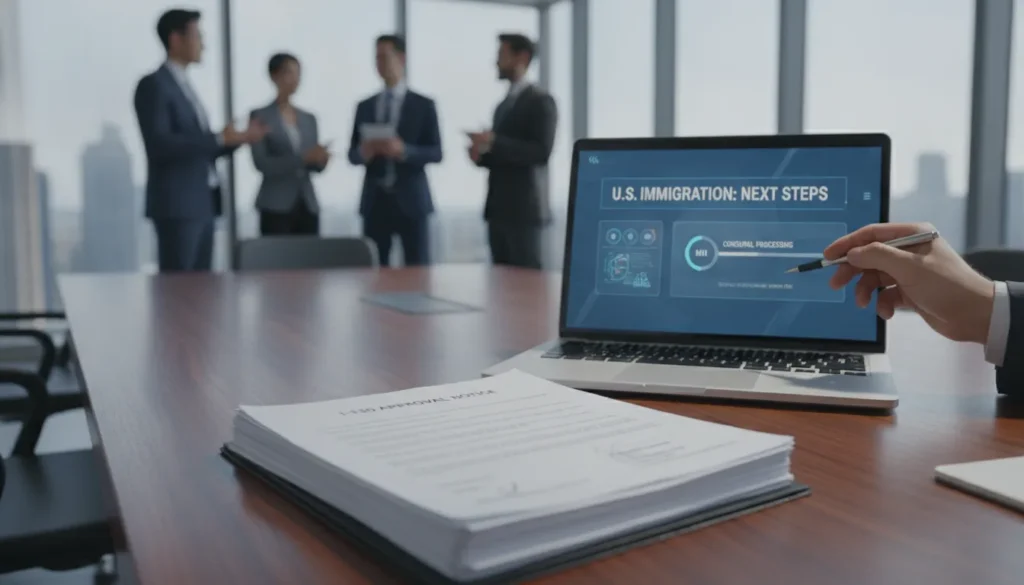
If USCIS approves your family petition, you may be wondering when your loved one can travel to the United States. The answer depends on what comes next. Consular processing after I-130 approval can involve NVC case creation, fees, online forms, supporting documents, a medical exam, and an interview abroad. An approved petition confirms the qualifying family relationship, but it does not guarantee a visa or set an interview date. Knowing what each stage means can help you track your case and respond to requests with confidence. Below, we explain the process and the documents families commonly need to prepare.
Key Takeaways
- I-130 approval is only the first step: It confirms the qualifying family relationship, but the beneficiary still needs to complete consular processing and qualify for an immigrant visa.
- Follow case-specific instructions and track updates: Check visa availability when relevant, submit complete forms and documents through CEAC, and prepare for the medical exam and interview.
- Wait for visa issuance before traveling: Check the visa’s expiration date, follow post-arrival requirements, and seek legal guidance if you face delays, document concerns, or possible inadmissibility.
What Does I-130 Approval Mean for Consular Processing?
Approval of Form I-130 confirms that U.S. Citizenship and Immigration Services (USCIS) has recognized the qualifying family relationship in the petition. It does not complete the immigration process or give the beneficiary permission to enter the United States. The next steps depend on where the beneficiary lives and whether a visa is available in their category.
How consular processing differs from adjustment of status
Consular processing is generally used when the beneficiary lives outside the United States. After USCIS approves the I-130, the case moves to the National Visa Center (NVC), which provides instructions for fees, forms, and supporting documents. The case then proceeds to a U.S. embassy or consulate abroad for an immigrant visa interview. The Department of State’s overview of the immigrant visa process explains these stages.
Adjustment of status is a separate process for some people who are already in the United States and eligible to apply for permanent residence without attending an immigrant visa interview abroad. An approved I-130 does not automatically qualify someone to adjust status. Eligibility depends on details such as immigration history, family category, and visa availability. If you are uncertain which process applies, consider speaking with an immigration lawyer before making travel or filing decisions.
Why I-130 approval does not grant an immigrant visa
The I-130 is a family petition. Its approval confirms the qualifying relationship, but it does not issue an immigrant visa, grant permission to enter the country, or make the beneficiary a permanent resident. The beneficiary must complete the required NVC steps, submit an immigrant visa application and financial sponsorship documents, and provide civil records.
The process also includes a medical examination and an interview with a consular officer. The officer reviews the application and determines whether the beneficiary qualifies for a visa. They may request additional evidence or further review before making a decision. In other words, I-130 approval lets the case move forward, but it does not guarantee visa issuance. The Department of State’s petition guidance describes the petition’s role in the larger process.
How immediate relatives, preference categories, and priority dates affect the case
Some beneficiaries are immediate relatives of U.S. citizens, including spouses, unmarried children under 21, and parents of U.S. citizens who are at least 21. Immediate relatives are not subject to annual numerical limits on immigrant visas, though they still need to complete the required NVC and consular steps.
Other qualifying relatives fall into family preference categories, such as certain adult children and siblings of U.S. citizens, or spouses and children of green card holders. These categories have annual visa limits, so an approved petition may be followed by a wait. The beneficiary’s priority date, generally the date USCIS received the petition, determines their place in line. Check the Department of State’s monthly Visa Bulletin for updates. The chart and category that apply can affect when the beneficiary may proceed and when a visa can be issued.
What Happens After I-130 Approval?
An approved Form I-130 confirms that U.S. Citizenship and Immigration Services (USCIS) recognizes the qualifying family relationship. It does not grant an immigrant visa or permanent resident status. If the beneficiary will apply for a visa at a U.S. embassy or consulate abroad, the case generally moves to the National Visa Center (NVC) for further processing.
The next steps usually include checking visa availability, paying fees, completing forms, and submitting supporting documents. Follow the notices in your case closely: requirements and timing can vary by visa category, applicant, and consular post.
How the NVC creates a case and provides CEAC access
After USCIS approves an I-130 filed for consular processing, it generally sends the petition to the NVC. The NVC creates a case file and assigns a case number. When the case is ready for further processing, the NVC typically sends a welcome notice with instructions for accessing the Consular Electronic Application Center, known as CEAC.
Keep the notice somewhere secure. You’ll need the case number and invoice identification number to sign in. CEAC is used to pay fees, complete the immigrant visa application, and submit supporting documents. Check your account and the email address associated with the case regularly so you don’t miss a request or instruction. The Department of State explains the NVC process, from receiving an approved petition to preparing a case for consular review.
How to check visa availability before paying fees or submitting forms
First, identify the visa category listed on the petition. Immediate relatives of U.S. citizens, including spouses and certain children and parents, are not subject to annual visa limits. Family preference categories are limited, so beneficiaries may need to wait for a visa to become available.
For a preference case, compare the beneficiary’s priority date with the relevant dates in the Department of State’s monthly Visa Bulletin. The applicable chart and cutoff date depend on the category and the beneficiary’s country of chargeability. The NVC will tell you when to pay fees and submit documents. In some cases, document processing can begin before a visa is available for final action, so follow the notice for your case rather than assuming you must wait to do anything. Petition approval alone does not mean an interview can be scheduled.
How to pay fees and complete a DS-260 for each applicant
When fees become available, sign in to CEAC and follow the payment instructions in your NVC notice. The fees generally include the immigrant visa application processing fee and, when required, the Affidavit of Support fee. Allow time for payment processing, and wait for CEAC to show that payment has been accepted before proceeding.
Each person applying for an immigrant visa generally needs a separate Form DS-260. Provide accurate information about addresses, employment, family relationships, travel, and immigration history. Review the application carefully before submitting, then save or print the confirmation page for the interview. The Department of State’s DS-260 instructions explain how to complete the online form. If you notice an error after submission, follow the embassy or consulate’s instructions for requesting a correction.
How to submit Form I-864 and financial sponsorship evidence
The petitioner generally must submit Form I-864, Affidavit of Support, even if another person will also sponsor the immigrant. By signing, the sponsor accepts financial responsibilities described in the form. The petitioner typically provides evidence such as federal tax records and proof of current income. Check the NVC’s instructions for the specific forms and records required in your case.
If the petitioner does not meet the financial requirements, a qualifying joint sponsor may be able to help. The joint sponsor submits a separate I-864 and supporting financial evidence. Eligibility can depend on income, household size, assets, and U.S. domicile. Review the Department of State’s Affidavit of Support guidance before submitting documents. If income, household members, or sponsorship arrangements are complicated, legal guidance can help you understand which evidence may be needed.
How to upload documents, check CEAC, and respond to NVC notices
After submitting the DS-260, upload the requested civil and financial documents through CEAC. Follow the NVC’s instructions for file formats, document categories, and translations. Make sure every scan is complete and easy to read, including all relevant pages. Blurry images, missing pages, or documents placed in the wrong category may lead to a request for correction.
Check CEAC for status changes and messages, and monitor the email address linked to your case. If the NVC requests a document or correction, respond using the method and within the timeframe stated in its notice. Keep copies of submitted files and payment confirmations. Applicants can sign in to the CEAC portal to access their case and submit materials. If a notice is unclear, review its instructions carefully before sending documents.
What documentarily qualified means, and why it does not guarantee an interview
A case is generally considered documentarily qualified when the NVC has received and accepted the required fees, forms, and supporting documents. This means the case is ready for the next stage, but it does not mean the beneficiary has received a visa or will have an interview immediately.
The case may wait for an appointment at the embassy or consulate. For family preference categories, visa availability can also affect when an interview may be scheduled. Appointment timing depends on the visa category, whether a visa is available, and the consular post’s capacity. The NVC or embassy will send instructions when an interview is arranged. Keep your contact details current and watch for official updates. If you have questions about a delay, priority date, or case-specific concern, family-based immigration counsel can help you understand your options.
Which Documents Should You Prepare?
After the National Visa Center (NVC) creates your case, you’ll submit civil documents and financial sponsorship evidence through the Consular Electronic Application Center (CEAC). The exact list depends on the applicant’s history, visa category, and country of residence. Follow the instructions in your case and check the requirements of the U.S. embassy or consulate handling the interview.
Start collecting records early. Some documents take time to obtain, and requirements can differ by country. Make sure each document is complete, readable, and consistent with the information on your forms. If a record is missing, unavailable, or contains a name or date that differs from other paperwork, check the official instructions before submitting anything in its place.
Daniel Ogbeide Law’s immigration law team works with Houston-area families on family-based immigration matters. An attorney can help you identify potential document concerns and understand what steps may apply to your case.
Gather the beneficiary’s passport, birth certificate, and police certificates
The beneficiary, the person seeking an immigrant visa, will generally need a valid passport and civil records such as a birth certificate. Police certificates may also be required, depending on the applicant’s age and where they have lived. The specific rules, issuing authorities, and acceptable records vary by country.
Use the Department of State’s country-specific civil document guidance to check what applies. Compare names, birth dates, and other details across the passport, application, and supporting documents. If a record uses a different name or spelling, gather documents that explain the difference, such as a marriage certificate or legal name-change record.
Collect marriage, divorce, adoption, court, and military records, if applicable
Gather records that show family relationships and relevant life events. Depending on the case, these may include marriage certificates, divorce decrees, annulment records, adoption documents, or court orders. Some applicants may also need military records or other documents requested by the NVC or consulate.
Check whether the issuing country requires an original, certified copy, or another official version. A photocopy or translation may not meet the requirement on its own. Prior marriages and adoptions can affect the evidence needed to establish a qualifying family relationship, so don’t leave out related records because they seem unrelated to the petition. Review the Department of State’s required civil document guidance alongside your case-specific instructions.
Prepare the sponsor’s tax records, income evidence, and proof of U.S. domicile
The petitioner generally submits Form I-864, Affidavit of Support, to show that financial sponsorship requirements are met. Gather the sponsor’s federal tax information and evidence of current income. Depending on the circumstances, this may include pay statements, an employer letter, or records of self-employment income. Follow the form instructions to confirm which tax documents are required.
The petitioner must also meet the U.S. domicile requirement. In general, this means maintaining a principal residence in the United States or taking steps to reestablish one. The evidence needed can depend on the sponsor’s situation. Review the current Form I-864 instructions and NVC guidance before uploading documents. Missing financial evidence or unclear information about domicile may lead to a request for additional documents.
Gather joint sponsor documents, if needed
If the petitioner does not meet the income requirement, a qualifying joint sponsor may be able to provide additional financial sponsorship. The joint sponsor files a separate Form I-864 and must independently meet the applicable requirements. They generally submit tax records, proof of current income, and evidence of U.S. citizenship or lawful permanent resident status.
A joint sponsor’s income is not simply added to the petitioner’s without the required forms and evidence. Check the USCIS Affidavit of Support instructions to confirm what the joint sponsor needs to provide. If a household member’s income will be included, additional forms or supporting records may be necessary. Make sure the sponsor understands the requirements before submitting documents through CEAC, and check the NVC’s instructions for any case-specific directions.
Meet translation and country-specific requirements and address unavailable records
A document that is not in English may need a complete translation. Follow the instructions from the NVC and the interviewing embassy or consulate, including any rules about translator certification. Country-specific requirements can also determine which issuing authority, document format, or record is acceptable.
If a required document does not exist or cannot be obtained, don’t assume that an informal statement will be accepted instead. Check the Department of State’s country-specific document guidance to see whether the record is considered unavailable and what alternatives may be accepted. Keep evidence of your attempts to obtain it, and follow any instructions from the NVC or consulate about substitute documents.
Use a checklist and clear, consistent scans to prevent submission problems
Build a checklist from the NVC’s instructions and the requirements of the embassy or consulate handling the interview. Track whether each item has been obtained, translated if needed, scanned, and uploaded. Before submitting, check that every scan is readable and includes all pages, stamps, and seals. Use clear filenames so you can identify documents easily.
Compare names, dates, and other details across forms and records. If you find a discrepancy, determine whether you need an explanation or supporting document. Check CEAC and your email regularly for notices about missing or unacceptable items. The Department of State’s NVC document submission guidance explains how to submit case materials and monitor requests.
Keep copies and bring original documents to the interview
Save copies of every form and document you submit, along with NVC notices and confirmation pages. Organize the original or certified records you may need to show at the interview. Requirements vary by consulate, so check whether the post asks for originals, certified copies, or both. Bring updated financial evidence if the sponsor’s circumstances have changed or the consulate requests it.
If a panel physician gives you a sealed medical exam envelope, do not open it. Follow the physician’s and consulate’s instructions for handling it. The Department of State’s interview preparation guidance explains what to bring and how to handle sealed medical documents. Keep your paperwork organized so you can respond if the consular officer requests more information.
How Long Does Consular Processing Take?
There is no set timeline for consular processing after I-130 approval. The wait depends on visa availability, how quickly the National Visa Center (NVC) reviews the case, and how soon the responsible U.S. embassy or consulate can schedule an interview. Medical exams, missing documents, and additional review can add time, too.
How long the NVC takes to create and review a case
After U.S. Citizenship and Immigration Services approves the I-130, it sends the petition to the NVC. The NVC creates a case, assigns a case number, and provides instructions for paying fees and accessing the Consular Electronic Application Center (CEAC). Transfer and case creation times vary, so check the NVC’s current processing timeframes rather than relying on a general estimate.
Once you submit the DS-260, Form I-864, and supporting documents, the NVC reviews them. If a form is incomplete or a document is unclear, you may need to correct and resubmit it. Follow the instructions in your case notices and respond as soon as you can.
How priority dates and visa availability affect the wait
Some family-based applicants can continue toward an immigrant visa once their case is ready for consular processing. Immediate relatives of U.S. citizens, including spouses, unmarried children under 21, and parents of adult U.S. citizens, are not subject to annual visa limits.
Other family-based applicants fall into preference categories with limited visa numbers. These applicants may need to wait until their priority date is current before a visa can be issued. The wait varies by category and, in some cases, the beneficiary’s country of birth. Check the Department of State’s Visa Bulletin each month. An approved I-130 does not by itself mean that a visa number is available.
How embassy or consulate backlogs affect interview timing
After the NVC accepts the required forms and documents, it marks the case documentarily qualified. The case then waits for an interview appointment at the embassy or consulate handling it. Appointment availability varies by location and can depend on the post’s workload, staffing, and the number of cases waiting.
Documentarily qualified does not mean an interview will be scheduled right away. The Department of State’s visa appointment wait-time information offers general estimates, but it cannot predict when a particular applicant will receive an appointment. Check your email and CEAC for notices specific to your case, and follow any instructions from the NVC or consulate.
How the medical exam, visa decision, and administrative processing affect timing
Before the interview, each applicant must complete a medical exam with a physician authorized by the U.S. embassy or consulate. Follow the post’s instructions for scheduling the exam and bringing vaccination records or other requested information. Review the Department of State’s medical examination guidance as soon as you receive interview instructions. Appointment availability or follow-up medical requirements may affect your schedule.
The consular officer may not make a final decision at the interview. The officer could request additional documents or place the application in administrative processing. Review times vary, and the consulate may not be able to give you a completion date.
Why timelines vary and documentarily qualified cases may still wait
Consular processing involves several stages, and a delay at one stage can affect the next. The NVC may ask for corrected forms or clearer scans. Applicants in preference categories may be waiting for a visa number, while other applicants may be waiting for an interview appointment. A consular officer may also request more evidence after the interview.
Documentarily qualified means the NVC has accepted the required forms and documents. It does not mean an interview is scheduled, a visa is available, or the visa is approved. Submit complete, readable records and respond promptly to requests to help avoid preventable delays. If your case involves complicated immigration or family circumstances, an immigration lawyer can help you understand your options.
Track official updates, check the Visa Bulletin, and keep contact details current
Check CEAC and your email regularly for NVC messages, document requests, and interview notices. Use the CEAC portal to review your case and follow the instructions provided for your application. Keep your email, mailing address, and phone number current with the appropriate agency so important notices reach you.
If you are in a family preference category, review the Visa Bulletin each month to see whether your priority date is current. Check the embassy or consulate’s website for local interview instructions, too. Keep copies of submitted forms and notices, and respond quickly when you receive a request. If a notice is unclear or a delay concerns you, an immigration attorney can review your circumstances and discuss possible next steps.
How Can You Prepare for the Visa Interview?
The immigrant visa interview is an important step in consular processing. A consular officer reviews your application, supporting documents, and eligibility, and may ask about your relationship with the petitioner, your background, or information in your forms. Preparing ahead can help you answer clearly and identify missing or inconsistent records before your appointment.
Start with the instructions from the U.S. embassy or consulate handling your case. Procedures vary by location, so rely on your appointment notice and that post’s current guidance rather than another applicant’s experience. Confirm what to bring, whether you need to upload documents in advance, and how to handle translations, photographs, and medical results. The U.S. Department of State’s interview preparation guidance offers a general overview, but your embassy’s instructions are the ones to follow for your appointment.
Give yourself time to schedule the medical exam, organize original records, and review your DS-260. If you find a mistake or cannot obtain a required document, do not wait until interview day to address it. Contact the embassy or consulate through its official channel, or seek legal advice if the issue could affect eligibility. Careful preparation cannot guarantee a visa, but it can help you respond promptly and follow the correct process.
Follow the embassy’s instructions and document checklist
Read your appointment notice and the embassy or consulate’s interview instructions closely. Check which documents you must bring, whether any records must be uploaded before the interview, and what rules apply to translations, photographs, and copies. These requirements can vary by post, so do not rely only on general advice or a checklist used by someone interviewing elsewhere.
Create a checklist based on the instructions and gather each item as early as possible. If a required record is unavailable, follow the post’s guidance on unavailable documents or contact the consulate for direction. Some posts may require applicants who arrive without necessary documents to reschedule. The State Department’s interview preparation page provides general guidance, but use your post’s checklist to confirm what applies to your case.
Schedule a medical exam with an authorized panel physician
After your interview is scheduled, arrange the required medical exam with a physician authorized by the U.S. embassy or consulate. A regular doctor cannot perform the immigration exam unless they are an approved panel physician. Check the post’s website for its list of authorized physicians and instructions for booking.
Schedule the exam in line with the consulate’s timing guidance, leaving enough time to complete any required tests or vaccinations. Ask the physician what to bring, such as identification, vaccination records, or photographs. Medical results may be sent directly to the consulate, or the physician may give you a sealed envelope to bring to the interview. Follow the instructions you receive, and do not open a sealed envelope. The Department of State’s interview guidance explains the exam requirement; your panel physician and embassy can confirm the process for your location.
Bring original documents, updated financial evidence, and interview notices
Bring the original civil documents requested for your case, along with translations and photocopies if the post requires them. Depending on your circumstances, these may include birth and marriage certificates, divorce decrees, police certificates, or court records. Check your appointment notice for the specific list, and include the interview confirmation and any relevant notices from the National Visa Center or consulate.
Prepare current financial sponsorship evidence, too. If the petitioner’s income or circumstances have changed since filing Form I-864, bring recent records that reflect the change, such as tax documents, pay statements, or an employment letter. A joint sponsor should bring their own required supporting evidence. Organize your papers in labeled sections so you can find them easily if asked. The State Department’s interview instructions provide general direction, but follow the document requirements in your appointment notice.
Review the DS-260 and answer questions truthfully and consistently
Before the interview, review the DS-260 you submitted and make sure you understand the information it contains. Refresh your memory about dates, addresses, employment, travel, and family details. Your answers should be consistent with your application and supporting records. If you notice an error or realize you left out information, do not try to conceal it. Contact the consulate or get legal advice about how to address it.
During the interview, listen to each question and answer honestly in your own words. If you do not remember a detail, say so rather than guessing. The officer may ask about your relationship with the petitioner, prior immigration history, or information in your application. Review the Department of State’s DS-260 information if you need to revisit the form. If your case involves complicated history or past inconsistencies, consider speaking with an immigration lawyer before the appointment.
Understand visa approvals, 221(g) requests, and other refusals
An interview does not mean a visa will be issued that day. The consular officer may approve the application, refuse it, or ask for additional documents or review. A refusal under section 221(g) generally means the officer needs more information or must complete administrative processing before deciding whether the applicant qualifies. It is not always a final denial, so read the written notice carefully and follow its directions.
The notice should explain whether documents are missing, how to submit them, or whether further processing is needed. Keep a copy of the notice and anything you provide in response. Do not assume a request guarantees approval once you send the requested information. The State Department’s explanation of visa refusals describes common outcomes. If you do not understand the reason for a refusal or the next steps, consider getting legal advice before responding.
Ask how and when to submit any requested documents
If the officer requests more documents, make sure you understand exactly what is needed and how to submit it. Ask whether the consulate expects an upload through CEAC, delivery by courier, or another method. Confirm any deadline, translation requirements, file format, and whether it needs an original document. Do not send original records unless the instructions specifically require them.
Save proof that you uploaded or delivered the documents, then monitor your email and case status for updates. Respond promptly, but check that each document is complete and readable before sending it. If the request is unclear, contact the consulate through its official channel instead of guessing. For help understanding a complicated request or an eligibility concern, you can speak with an attorney experienced in immigration law.
What Causes Delays—and How Can You Address Them?
Consular processing involves several steps, and different issues can slow a case at different points. Missing records, financial sponsorship questions, visa availability, interview capacity, and security checks may all affect timing. Some delays are preventable, such as those caused by an unreadable scan. Others depend on agency or consular workloads and may be outside your control.
Keep copies of every form, document, and notice you submit. Check your case messages and email regularly, and respond to requests as soon as you can. If you are unsure how to address a concern, consider getting legal advice before sending a response.
Correct missing, inconsistent, or incorrectly uploaded documents
The National Visa Center (NVC) may request additional evidence if a document is missing, incomplete, or hard to read. Common issues include missing birth or marriage certificates, divorce decrees, police certificates, or evidence of the family relationship. Differences in names, dates, or other details across records can also prompt questions.
Before uploading documents, check the Department of State’s civil documents guidance for the beneficiary’s country. Confirm that each scan is complete and legible, and upload it to the correct category in CEAC. If a required record is unavailable, follow the country-specific instructions for explaining why and providing an acceptable alternative. Save a copy of each file and note the date you submitted it so you can refer back to your records if the NVC asks for clarification.
Resolve financial sponsorship gaps and joint sponsor requirements
Form I-864, Affidavit of Support, is used to show that the intending immigrant has financial support in the United States. The petitioner generally must submit an affidavit, even if they do not meet the income requirement. If the petitioner’s income is not sufficient, a joint sponsor may be able to help. That person must meet the applicable requirements and submit a separate affidavit with supporting evidence.
Review the NVC’s Affidavit of Support guidance before preparing the forms. Gather the sponsor’s tax records and evidence of current income, and check whether proof of U.S. domicile is needed. Make sure household size and income details are consistent across the forms and supporting documents. If the sponsor’s income, household, or residence situation is complicated, consider getting legal advice before submitting the packet.
Account for visa limits, consular workloads, and security checks
Some family-based immigrant visas are subject to annual numerical limits. Immediate relatives of U.S. citizens are not subject to these limits, but applicants in family preference categories may need to wait until a visa is available based on their priority date. The Department of State’s Visa Bulletin provides monthly information about visa availability. Check it regularly, since a case may not be ready to move forward simply because the I-130 petition has been approved.
Interview timing also depends on the appointment capacity and workload of the U.S. embassy or consulate handling the case. Some applications require additional security or administrative processing, which can add time. These factors may be outside your control, so keep your contact information current and follow official updates. Avoid making firm travel plans until the immigrant visa has been issued.
Get legal advice about prior immigration violations or possible inadmissibility
A history of unlawful presence, a prior removal, a criminal record, or possible misrepresentation can raise questions about eligibility for an immigrant visa. A consular officer may also have concerns about the evidence or information in an application. The effect of an issue depends on the person’s specific history, and a waiver may not be available in every situation.
If any of these concerns may apply, speak with an immigration lawyer before submitting an explanation or responding to a consular request. An attorney can review the facts, identify records that may matter, and discuss potential next steps. Daniel Ogbeide Law assists clients with family-based immigration matters through its immigration law services. Getting guidance before you respond can help you understand the risks and avoid relying on assumptions about how a past event may affect the case.
Respond promptly to official requests and track your case
If the NVC or a consular post asks for more information, read the notice carefully. Identify what is requested, how to submit it, and whether the notice sets a deadline. Follow the instructions and save proof of your submission. If you cannot obtain a document in time, check the notice for guidance on explaining the issue rather than leaving the request unanswered.
Check CEAC and your email regularly, including spam folders, and make sure the NVC has your current contact information. Use the CEAC website to review case messages and document status. Keep a simple log of notices, submission dates, and follow-up steps. Organized records make it easier to confirm what you have sent and respond accurately if the agency asks about a document or filing.
Act on NVC notices and keep your case moving
NVC notices may ask you to pay a fee, complete a form, or replace a document. Read each notice in full and follow the instructions in the order provided. If a document is rejected, review the stated reason, correct the problem, and upload a clear replacement through the designated channel.
A “documentarily qualified” notice means the NVC has accepted the required forms and documents. It does not guarantee that an interview will be scheduled right away. The case may still wait for an appointment, and applicants in visa-limited categories may also need to wait for a visa to become available. Check the NVC’s case processing information for updates on review timelines. If a notice is unclear or your case seems inactive beyond the posted timeframe, use the official inquiry process or ask an immigration lawyer about appropriate follow-up.
What Happens After the Immigrant Visa Is Approved?
An approved immigrant visa is an important step, but there are still a few things to take care of before and after you travel. Check the visa and any instructions from the embassy or consulate as soon as you receive your passport. Pay attention to deadlines, required fees, and instructions about documents. The Department of State’s post-interview guidance explains what applicants may need to do after an interview, including responding to requests for additional information.
You generally become a lawful permanent resident only after a Customs and Border Protection officer admits you to the United States using your immigrant visa. Until then, the visa’s expiration date and any outstanding consular steps matter. Keep copies of your visa-related documents and make sure the U.S. mailing address on file is correct. The USCIS overview of consular processing describes the process from visa issuance through arrival in the United States. Requirements can vary by case, so follow the specific instructions you receive.
Check the visa’s expiration date and follow consulate instructions
Check the expiration date printed on your visa as soon as you get your passport back. Immigrant visas are valid for a limited time, and the expiration date may depend on the medical exam or other case details. Do not assume you have a standard amount of time to travel. Follow any instructions from the embassy or consulate about collecting documents, paying fees, or completing other steps.
If you cannot travel before the visa expires, contact the consulate promptly to ask what options, if any, are available. Do not wait until the final days, since an expired visa generally cannot be used to travel. Keep all notices and instructions with your immigration records. The Department of State’s information about what happens after the interview explains what to expect after a visa decision.
Wait for visa issuance before making firm travel plans
A consular officer’s approval does not always mean that your visa is ready for travel. The officer may need to complete administrative processing or review additional documents before issuing it. Wait until your passport is returned with the visa before booking nonrefundable travel, leaving a job, or making other major plans.
Check your case status and read every notice from the consulate carefully. If the consulate asks for more information, submit it using the method and deadline provided. Keep copies of everything you send. The Department of State’s post-interview guidance describes possible next steps, including administrative processing and requests for documents. If you are unsure how to respond, an immigration lawyer can help you understand the request and consider how it may affect your case.
Pay the USCIS immigrant fee and travel before the visa expires
Many new immigrants must pay the USCIS immigrant fee, which covers processing and delivery of the Permanent Resident Card, commonly called a Green Card. Review the USCIS immigrant fee instructions to confirm whether the fee applies to you, how to pay, and whether any exceptions are relevant. Keep the payment confirmation with your immigration records.
You can generally pay the fee before or after arriving in the United States, but paying before you travel can help USCIS begin processing your card sooner. Each family member may have separate requirements, so check the instructions for every person immigrating with you. Make sure you travel while your visa is valid. If you cannot enter before the expiration date, contact the consulate for guidance rather than assuming the visa can be extended.
Present the visa for inspection at a U.S. port of entry
When you arrive in the United States, present your passport and immigrant visa to a Customs and Border Protection (CBP) officer. If the consulate gave you a sealed packet, leave it sealed and give it to the officer as directed. Some cases use electronic records instead, so follow the instructions you received from the consulate.
The CBP officer will review your documents and decide whether to admit you as a permanent resident. Answer questions truthfully and provide any information the officer requests. Keep your passport and immigration documents secure after inspection. The Department of State’s arrival instructions explain what to expect when traveling with an immigrant visa. If you have questions about your documents before departure, ask the consulate or seek legal advice.
Learn about permanent resident admission and Green Card delivery
If CBP admits you with your immigrant visa, you generally become a lawful permanent resident on the date of admission. In many cases, the officer’s endorsement of your immigrant visa serves as temporary proof of permanent resident status while you wait for your Green Card. Check your passport and any documents you receive for information about how long that temporary proof can be used.
USCIS mails your Green Card to the U.S. address provided for your case after the required fee is paid and processing is complete. Make sure the address is accurate and that someone can receive mail there. If you move, follow USCIS instructions to update your address. If the card does not arrive within the expected timeframe, check USCIS guidance on receiving your Green Card. Keep copies of your visa, admission records, and fee receipt.
Check whether conditional residence or future filing deadlines apply
If you immigrate based on a marriage that was less than two years old on the date you entered the United States, you generally receive conditional permanent resident status. Your Green Card is usually valid for two years. To remain a permanent resident, you and your spouse generally must file Form I-751 during the 90-day period before the card expires.
Mark that filing window on your calendar and keep records that show your marriage is genuine, such as shared financial, housing, and family documents. Certain situations may allow a person to request a waiver of the joint filing requirement. Review USCIS guidance on conditional permanent residence for current instructions. If your relationship or circumstances have changed, consider getting legal advice before filing. Houston-area families can learn about family-based immigration representation from Daniel Ogbeide Law.
When Can an Immigration Lawyer Help?
Get help with documents, sponsorship, or interview concerns
After I-130 approval, an immigration lawyer can help you understand what the National Visa Center (NVC) needs and organize your next steps. The NVC collects fees, civil documents, and financial sponsorship evidence before a case can proceed to an interview. A lawyer can review your records for missing information or inconsistencies and help you understand the requirements that apply to your case.
You can also ask for guidance with Form DS-260, Form I-864, and whether a joint sponsor may be necessary. Before the interview, an attorney can help you review the instructions, prepare required original documents, and understand what to expect. Learn more about what happens during the NVC stage and the steps that follow petition approval.
Seek guidance on prolonged delays, inadmissibility, or waiver options
If your case has been waiting longer than expected, an attorney can help you review NVC or consulate notices and determine whether the agency needs additional information. Delays may relate to visa availability, processing backlogs, or incomplete documents. Common reasons for requests for evidence include missing civil records, incomplete financial sponsorship evidence, and unclear or inconsistent information.
Consider seeking legal advice if the applicant has a prior immigration violation, criminal history, or another circumstance that could affect admissibility. Some applicants may qualify for a waiver, but eligibility depends on their individual history and the rules that apply. An attorney can explain possible options, help you understand risks, and assist with preparing supporting documents. Because each case is different, a lawyer cannot guarantee a particular timeline or outcome.
Discuss family-based immigration with Daniel Ogbeide Law in Houston
I-130 approval is an important step, but it does not grant an immigrant visa or complete consular processing. If you have questions about sponsorship, document requests, interview preparation, or a delay, legal guidance can help you understand what applies to your situation and what to address next.
Daniel Ogbeide Law serves individuals and families in Houston and surrounding areas with family-based immigration matters. The firm can discuss your circumstances and explain how it may assist with the next stage of your case. Visit the firm’s page on immigration law services to learn more, or call 832-321-7005 to schedule a consultation. Before speaking with an attorney, gather your notices and submitted forms so you can describe your case clearly.
Related Articles
- I-130 Approved for Consular Case: What Happens Next?
- Common Reasons for Requests for Evidence in I-130 Processing
- USCIS Overview of Consular Processing
- Affidavit of Support: What You Need to Know
- Visa Bulletin: Understanding Priority Dates
Frequently Asked Questions
Does an approved I-130 mean the beneficiary can travel to the United States?
No. I-130 approval confirms the qualifying family relationship, but the beneficiary still needs an immigrant visa and must be admitted by a Customs and Border Protection officer at a U.S. port of entry. Wait until the visa is issued before making firm travel plans.
What should I do if I haven’t received instructions from the National Visa Center?
Check the USCIS case status and the contact information associated with the petition. USCIS may need time to transfer the approved petition and for the NVC to create a case. If the expected timeframe has passed, review the NVC’s current guidance and use its official inquiry process if appropriate.
Can the beneficiary apply for adjustment of status instead of consular processing?
Possibly, if the beneficiary is in the United States and meets the eligibility requirements. An approved I-130 alone does not establish eligibility. Immigration history, visa category, and visa availability can affect which process is available, so consider getting legal advice before filing or traveling.
What happens if the NVC rejects a document or asks for more evidence?
Read the notice carefully to identify what needs correction and how to submit it. Replace or provide the requested material through the specified channel, and keep a copy of your response. If you cannot obtain a requested record or do not understand the notice, check official instructions or consult an immigration lawyer.
When should I contact an immigration lawyer about consular processing?
Legal guidance may be helpful if you have questions about financial sponsorship, inconsistent records, a prior immigration issue, a refusal, or a lengthy delay. Houston-area families can contact Daniel Ogbeide Law at 832-321-7005 to discuss their circumstances.