



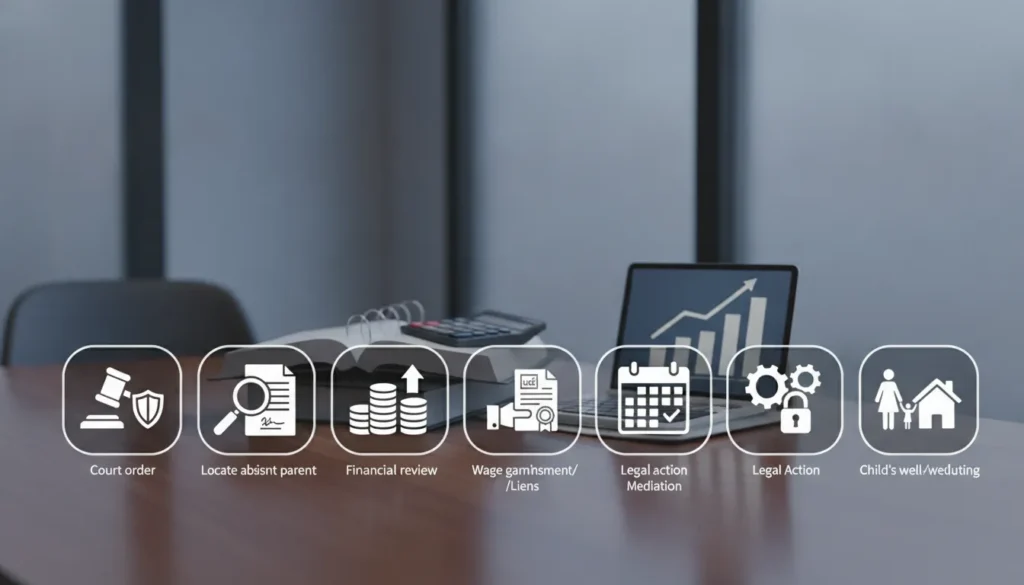
Late child support payments create more than a financial inconvenience. They can affect rent, groceries, medical care, childcare, and other expenses a child depends on every day. At the same time, informal solutions often create new problems. Cash payments, direct purchases, and verbal promises may be difficult to prove later, even when a parent acted in good faith. If you are learning how to enforce a child support order, begin by collecting the signed order, payment history, and proof of every payment or missed payment. You may also need information about the other parent’s address, employer, or assets. This guide explains common Texas enforcement options and when legal help may be useful.
Key Takeaways
- Treat the court order as the controlling document: Make payments through official channels, follow the stated schedule, and preserve receipts, account records, and written communications.
- Handle each legal issue separately: A financial hardship may require a formal modification, while unpaid support and parenting-time disputes must be addressed through their respective legal procedures.
- Get help early when complications arise: Review the payment history, document missing credits, report updated employment or location details, and consult a Houston family-law attorney about arrears, interstate enforcement, or contempt proceedings.
What Does a Child Support Order Require?
A child support order is a legally enforceable set of instructions explaining how a parent must contribute to a child’s financial needs. It typically identifies the amount due, the payment schedule, the date payments begin, and how long the obligation continues. The order may also address health insurance, medical expenses, childcare, education, and other costs related to raising the child.
In Texas, payments may be made through the state disbursement unit or collected through income withholding. Parents should follow the order as written, even if they reach a different private arrangement. A verbal agreement, cash payment, or promise to pay later may not protect either parent if official records show an unpaid balance. The Texas Office of the Attorney General’s child support resources explain payment and enforcement services available to eligible families.
A change in income or employment does not automatically change the order. A parent who loses a job, becomes disabled, or faces another substantial financial problem generally must request a formal modification. Reviewing the order carefully, keeping payment records, and getting legal guidance early can help prevent a manageable issue from becoming a larger enforcement dispute. Daniel Ogbeide Law’s family law attorneys help Houston-area parents understand their rights and responsibilities under child support orders.
Payment Amounts, Schedules, Duration, and Due Dates
A child support order states how much the obligated parent must pay and when each payment is due. Payments may be weekly, biweekly, monthly, or follow another schedule listed in the order. The document may also identify when support begins, how payments must be made, and whether income withholding applies.
The order usually explains when the obligation ends under Texas law. In some circumstances, support may continue longer, including when a child has a qualifying disability. Parents should review the order’s termination language instead of assuming support ends on a particular birthday.
Missing one payment can create a delinquency. Repeated missed payments may lead to arrears and enforcement action. If the payment amount or due date seems unclear, review the signed order and seek legal advice before relying on an informal interpretation.
Health Insurance and Medical Support
Child support orders often include separate provisions for medical and dental support. One parent may be required to provide health insurance when coverage is available at a reasonable cost. The order may also assign responsibility for uninsured medical, dental, vision, prescription, or other health-related expenses.
The order may establish how parents divide these costs and how reimbursement requests must be submitted. A parent who pays an eligible bill should keep receipts, invoices, insurance explanations of benefits, and proof of payment. Some orders also impose deadlines for sending documentation or requesting reimbursement.
Texas Law Help explains that unpaid medical and dental expenses, including qualifying uninsured costs, may support a money judgment. Parents can review its guidance on enforcing child support orders and gather the records needed to show what was paid, what insurance covered, and what remains due.
Childcare, Education, and Other Shared Costs
Some child support orders address expenses beyond the regular monthly payment. These may include work-related childcare, school supplies, tuition, extracurricular activities, transportation, or other costs connected to the child’s needs. The order may require one parent to pay a fixed amount, reimburse a percentage, or share an expense after receiving proper documentation.
Do not assume every expense is automatically reimbursable. The wording of the order controls. For example, an order may cover childcare that allows a parent to work but exclude optional activities, or it may require advance notice before a parent incurs a significant expense.
Keep invoices, receipts, enrollment records, payment confirmations, and written communications about these costs. If parents disagree about whether an expense is covered, ask for clarification in writing and review the order with a Houston family-law attorney. Clear documentation can make it easier to request payment or address an enforcement dispute.
Current Support, Arrears, Interest, and Payment Credits
A child support account may include current support and arrears. Current support is the amount due for the present period. Arrears are unpaid amounts from earlier due dates, and they generally remain due until paid or resolved through a lawful court process. Interest or other authorized charges may also increase the balance.
Payment records can become difficult to reconcile when a parent uses several methods, such as wage withholding, money orders, online transfers, direct deposits, or cash. A parent who believes the account balance is wrong should collect proof of every payment and compare it with the official payment history.
Do not assume a payment made directly to the other parent will automatically receive credit. The Texas OAG explains child support payment options, including methods that create a reliable record. If a credit is missing, address the issue promptly and preserve bank records, receipts, messages, and other proof before an enforcement hearing.
Why Child Support Does Not Control Custody or Visitation
Child support, custody, and visitation are separate legal issues. A parent generally cannot stop paying support because the other parent denied visitation. Likewise, a custodial parent generally cannot withhold visitation because payments are late. Each obligation remains governed by its own court order.
A parent who is being denied parenting time should use the enforcement process for possession or access. A parent who is not receiving support should use child support enforcement procedures. Trading visitation for payments or creating informal payment arrangements can make both disputes harder to resolve and may violate an existing order.
Safety concerns require additional care. If family violence, coercive control, or a protective order is involved, do not arrange an informal exchange that could create a risk. Discuss the situation with a lawyer and follow all applicable court orders. Daniel Ogbeide Law handles family law matters involving child support, custody, protective orders, and related disputes in Houston and surrounding communities.
Why Does Child Support Go Unpaid?
Child support can go unpaid for several reasons, and understanding the cause can help determine the right response. A parent may fall behind after losing a job, becoming disabled, or serving time in jail. Others stop paying because of a custody dispute, relocate without updating their contact information, or rely on informal payments that are difficult to verify.
Financial hardship may explain missed payments, but it does not usually change an existing child support order automatically. Unless a court enters a new order, the original payment amount generally remains due. Unpaid amounts can become arrears, which may continue to accumulate and lead to enforcement action.
Texas enforcement tools may include income withholding, license suspension, liens, and other collection methods. The Texas Office of the Attorney General’s child support services explains how parents can apply for enforcement assistance and payment services.
If you are owed support, keep records of missed payments, communications, employment information, and any payments made outside the official system. If you are struggling to pay, request a formal modification as soon as possible. Speaking with a Houston family law attorney can help you determine whether enforcement, modification, or both may be appropriate.
Job Loss, Reduced Income, Disability, or Incarceration
Job loss, reduced hours, disability, or incarceration can make it difficult for a parent to meet a support obligation. These circumstances may support a request to modify child support, but they generally do not cancel or reduce the existing order on their own. The parent usually must file the appropriate request and provide financial records showing what has changed.
A parent should not wait until a large balance has accumulated before seeking help. Until a court signs a modified order, the original amount may continue to become due. The paying parent should make payments through the official system whenever possible and keep proof of each payment, even if the full amount is not affordable.
Enforcement consequences can also make employment more difficult. A suspended driver’s or professional license, contempt proceeding, or incarceration may interfere with a parent’s ability to find or keep work. Research published in Social Work Research discusses how these consequences can create additional barriers to meeting formal support obligations.
Custody Disputes and Parenting-Time Conflicts
Child support, custody, and visitation are separate legal issues. A parent generally cannot stop paying support because a visit was missed, a parenting schedule changed, or the other parent allegedly interfered with visitation. Similarly, a parent who receives support generally cannot withhold court-ordered parenting time solely because payments are late.
Texas law addresses possession and access separately from financial support obligations. The Texas Family Code provisions on possession and access provide the framework for parenting-time arrangements, while child support orders address the child’s financial needs.
If parenting time is being denied, the affected parent may need to address that issue through a custody enforcement action or another appropriate court process. If child support is unpaid, the receiving parent can pursue collection separately. Keeping the issues separate helps avoid placing the child in the middle of an adult dispute and reduces the risk of violating an existing court order.
Informal, Cash, or Unrecorded Payments
Parents sometimes agree to exchange cash, pay expenses directly, or accept less than the ordered amount. These arrangements may appear practical, but they can create problems if the parties later disagree about what was paid. Without a receipt, transaction record, or other reliable proof, the paying parent may have difficulty receiving credit for the payment.
Direct purchases, such as clothing, groceries, or school supplies, may not replace court-ordered support unless the order or a later court-approved agreement specifically allows that arrangement. A verbal promise to accept a reduced payment may also be difficult to enforce or prove.
Use an official payment channel whenever possible. The Texas OAG provides instructions for making and receiving child support payments. Keep payment confirmations, receipts, money order records, canceled checks, and relevant messages. If the parents want to change the amount, payment schedule, or method, they should seek a formal modification instead of relying on an informal agreement.
Relocation, Job Changes, Hidden Income, or Unemployment
Enforcement can become more difficult when a parent changes jobs, moves to another state, works for cash, or fails to update an address. Relocation does not erase the support balance, but it may require additional steps to locate the parent and enforce the order across state lines.
If you believe the other parent has hidden income or started a new job, gather specific information that may help establish where the parent works or lives. This could include an employer’s name, business address, new residence, professional information, or statements about income. Share those details with the Texas OAG or your attorney instead of confronting or threatening the other parent.
The Texas OAG parent-locator program may help identify a parent’s address or employer when sufficient information is available. Enforcement may take longer when a parent is self-employed, paid in cash, unemployed, or living outside Texas. Organized records can help an agency or attorney identify useful leads and select the appropriate enforcement process.
Why Nonpayment Does Not Change the Order Automatically
A parent’s failure to pay generally does not reduce the amount due under an existing order. The order remains enforceable until a court enters a new one, even if the parent has lost employment, experienced a medical issue, or believes the amount is no longer affordable. Informal reductions and payment swaps may leave both parents with an inaccurate understanding of the balance.
A parent facing financial hardship should request a modification promptly. Courts generally do not allow a parent to avoid support obligations simply by delaying a request for relief. The National Council of Juvenile and Family Court Judges notes that avoiding litigation should not shift the financial responsibility for a child’s support to the other parent or the state.
Enforcement and modification are separate matters. The parent owed support may seek collection under the existing order, while the parent who cannot pay may request a change based on substantially changed circumstances. A later modification may affect future payments, but it does not necessarily erase arrears that accumulated before the new order.
How Can You Enforce a Child Support Order?
When a parent falls behind on court-ordered child support, begin by organizing the facts before taking legal action. Enforcement depends on the wording of the current order, the amount allegedly unpaid, the payment history, and the state responsible for enforcing the case. In Texas, the Office of the Attorney General Child Support Division may help with collection services, but a parent may also seek enforcement directly through the court.
Start with the signed order and any later modifications, then gather payment records and information about the other parent’s employment or location. These documents can help identify whether the issue involves missed payments, incorrect account credits, unpaid medical support, or a change in circumstances that requires modification instead of enforcement.
You may be able to request agency enforcement, file a private enforcement action, or use both options. The right approach depends on the case. Significant arrears, disputed payments, interstate orders, self-employment, hidden income, or an upcoming contempt hearing can make the process more complicated. A Houston family-law attorney can review the order, help calculate the balance, and explain which steps may apply.
Confirm the Order, Balance, and Enforcing State
Locate the most recent signed child support order, including any modification, clarification, or agreed order entered later. Review the required payment amount, due date, duration of support, medical-support obligations, and responsibility for childcare or other shared expenses. An informal agreement between parents does not automatically replace the court’s written order.
Next, determine which state and agency have authority over enforcement. A Texas case may involve another state if either parent relocated. Request the current arrears balance from the agency or court, then compare it with your own records. If a parent refuses to follow the order, the court may consider an enforcement action and, in some cases, contempt. The court still requires proper notice, admissible evidence, and an opportunity for the responding parent to be heard.
Compare Official Records With Your Own
Request a current payment history from the Texas OAG or the agency handling your case. Compare each entry with bank statements, money-transfer records, canceled checks, receipts, and other proof of payment. Check for differences in payment dates, amounts, processing delays, or credits applied to the wrong case.
Tell the caseworker promptly if the other parent has moved, changed employers, or started receiving income from a new source. Updated information can help the agency locate the parent or establish income withholding. Keep copies of documents you submit, along with confirmation numbers and written responses. The Texas OAG child support portal can provide account and payment information, although you may need to contact the agency directly to address an accounting dispute.
Create a Payment Ledger and Save Communications
Create a payment ledger showing the date each payment was due, the amount ordered, the amount received, and the remaining balance. Identify whether each payment came through an official channel or directly from the other parent. Attach supporting documents, including account statements, receipts, canceled checks, and money-transfer confirmations.
Save texts, emails, and letters about missed payments, proposed payment plans, or claims that support was paid in cash. Keep the original files when possible, and avoid altering screenshots or deleting messages. A clear, chronological record can help resolve an accounting dispute and support an enforcement filing. Your ledger should separate regular child support from medical expenses, childcare costs, or other shared obligations. An attorney can review the records and help determine which amounts are legally enforceable.
Gather Employer, Address, Income, and Asset Information
Collect any lawful information you have about the other parent’s current address, employer, job title, pay schedule, business interests, and assets. Helpful details might include a new workplace mentioned in a message, a public business filing, or a professional profile. Do not access private accounts, impersonate the parent, or obtain information through unlawful means.
Share relevant updates with the child support agency or your attorney. A known employer may make income withholding easier to establish, while reliable information about property or financial accounts may support other collection remedies. Depending on the circumstances, enforcement authorities may pursue a lien against qualifying property or use other lawful collection tools. Provide facts rather than assumptions, and identify information that still needs verification.
Choose Agency Enforcement, Court Enforcement, or Both
You may ask the Texas OAG Child Support Division for assistance, pursue private enforcement through the court, or use both options when appropriate. Agency services may include locating a parent, establishing income withholding, processing payments, and pursuing certain administrative remedies. However, an agency may not resolve every issue, especially when the dispute involves payment credits, complex income, or a request for contempt.
A private court action may be useful when you need to establish the exact arrears amount, challenge inaccurate records, request financial information, or seek a specific judicial remedy. Texas Law Help explains private child support enforcement and confirms that a parent does not have to rely exclusively on the OAG. Before filing, confirm whether an agency case is already open and whether another court has jurisdiction.
Use Official Payment Channels Going Forward
Ask that future payments go through the designated state disbursement or registry system whenever possible. Official channels create a record showing the amount paid, the date received, and the case credited. That information can reduce disputes about whether payment occurred and whether it applied to current support or arrears.
Use caution when accepting cash, paying bills directly, or exchanging support for clothing, transportation, or other items. These arrangements may not satisfy the written order and can make the account balance difficult to calculate. Keep every receipt and confirmation, and report payment-processing problems promptly. If both parents want to change the amount, due date, or payment method, seek a formal modification or court-approved agreement instead of relying only on a verbal promise. Timely, documented payments help meet the child’s needs and limit future disputes.
Protect Your Safety and Do Not Withhold Visitation
If conversations about unpaid support involve threats, harassment, stalking, or coercive control, prioritize your safety. Use written communication when appropriate, avoid private meetings, and share safety concerns with your attorney or caseworker. You may need a safety plan, supervised exchanges, or a protective order depending on the circumstances.
Child support and possession or visitation are separate legal issues. A parent generally cannot deny court-ordered visitation solely because the other parent has failed to pay support. If visitation creates a safety concern or the current schedule no longer works, ask the court to modify the parenting order rather than changing it unilaterally. Daniel Ogbeide Law’s family-law services assist Houston parents with support enforcement, custody disputes, and related protective-order concerns.
What Can a Child Support Agency Do?
A child support agency can help establish, collect, and enforce financial support, but it does not replace the court. In Texas, the Office of the Attorney General’s Child Support Division may help locate a parent, establish paternity, obtain or modify a support order, arrange income withholding, and collect past-due support.
Agency services can be helpful when direct communication has failed or when you need an official payment record. The agency may also use administrative enforcement tools, such as tax-refund intercepts, license suspension, property liens, and credit reporting, when a parent does not pay as ordered. Available remedies depend on the case, the amount of arrears, and legal requirements.
Still, agency involvement does not resolve every child support issue. A case may require court action when a parent disputes the amount owed, claims payments that do not appear in the agency’s records, requests a modification, or faces a contempt proceeding. You can review the Texas OAG’s child support services before deciding what type of help you need.
Open or Update a Texas OAG Child Support Division Case
A parent can apply for services through the Texas Office of the Attorney General’s Child Support Division. Depending on the circumstances, the agency may help establish paternity, obtain a child support order, collect payments, locate the other parent, and enforce an existing order. If you already have a court order, provide a complete copy so the agency can review its terms.
Keep the agency informed when your address, phone number, employer, or banking information changes. Report known changes involving the other parent as well, including a new address, employer, or income source. Your case may also need an update after a custody order, modification, payment arrangement, or medical-support provision changes.
Applying for agency services does not automatically change the support order. The existing order generally remains in effect until a court or authorized agency action modifies it. If your finances or parenting circumstances have changed, ask about the proper modification process instead of reducing payments on your own.
Contact the State IV-D Child Support Agency
“IV-D” refers to the government child support program operated through state and local agencies. In Texas, the OAG serves as the state child support agency. A parent who is struggling to make payments should contact the agency promptly, rather than waiting for arrears or enforcement actions to grow.
A caseworker may explain the payment history, identify missing information, discuss available enforcement steps, and provide instructions for requesting a review or modification. Contact the agency after job loss, disability, incarceration, or a change in custody. Save letters, emails, payment confirmations, and notes showing when you contacted the office.
Agency staff can explain case procedures, but they cannot give you individualized legal advice or represent you in a contested court hearing. If you disagree with the agency’s records or expect litigation, consider speaking with a Houston family-law attorney. The OAG provides contact information for child support cases and online account resources.
Use Parent-Locator Services to Find the Nonpaying Parent
A child support agency may use parent-locator services when a parent’s address, employer, or contact information is unknown. These searches can compare information from employment, tax, licensing, motor vehicle, and other government records. Details such as the parent’s full name, date of birth, Social Security number, last known address, and previous employers may make the search more effective.
Tell your caseworker when you learn that the other parent moved, changed jobs, remarried, or started a business. Even a partial address, employer name, vehicle detail, or social media profile may help narrow the search. Do not pursue information through unsafe contact or involve the child in locating the other parent.
Parent-locator services do not guarantee an immediate result. They also do not collect support without an enforceable order or establish legal parentage by themselves. The federal Federal Parent Locator Service supports state agencies with locating parents and identifying employment or asset information.
Address Paternity, Medical Support, or Order Gaps
Before an agency can enforce support against an alleged father, legal parentage may need to be established. This may occur through an acknowledgment of paternity, genetic testing, or a court order. If paternity is disputed, the agency may provide information about genetic testing and may ask the court to determine parentage.
A support order may also require health insurance, cash medical support, or payment of qualifying uninsured medical and dental expenses. Review the order to determine who must provide insurance, how expenses must be documented, and when reimbursement requests are due. Keep bills, insurance explanations of benefits, receipts, and written payment requests.
An agency may help establish or enforce medical support, but it cannot rewrite unclear terms whenever a disagreement arises. If the order does not address an issue or the parents disagree about its meaning, a court may need to clarify or modify it. The Texas OAG explains its role in establishing paternity and support.
Set Up Income Withholding and Centralized Payments
Income withholding directs an employer or another income source to deduct child support from the paying parent’s wages or qualifying benefits. The money is then sent through the state payment system and distributed according to the case records. This process can create a reliable payment trail and reduce the need for parents to arrange payments directly.
Depending on the order and applicable law, withholding may apply to wages, commissions, bonuses, unemployment benefits, workers’ compensation, or other income. Employers generally must follow the withholding notice and send payments through the required channel. A parent should not ask an employer to ignore the notice or replace official withholding with private payments.
Use official payment channels whenever possible. Cash, direct transfers, and payments made to relatives can create disputes if they are not credited to the case. Report a new employer promptly so withholding can be redirected. Texas provides information about child support payments and payment methods.
Request Tax, Benefit, Credit, License, Lien, or Levy Enforcement
When support remains unpaid, an agency may use administrative enforcement tools authorized by state and federal law. Depending on the case, these tools may include intercepting certain tax refunds, reporting arrears to credit agencies, placing liens on property, levying eligible accounts, or suspending a driver’s, occupational, or professional license.
These remedies usually involve eligibility requirements and notice procedures. The agency may need to confirm the arrears, send advance notice, and provide an opportunity to contest the action. If you receive an enforcement notice, do not ignore it, even if the balance appears incorrect. Respond by the deadline and provide proof of payments or other relevant records.
Enforcement action can affect a parent’s finances, employment, or ability to maintain a license. The Texas OAG explains several child support enforcement tools, although available remedies vary by case. Court action may still be necessary when administrative enforcement does not resolve the arrears.
Enforce Out-of-State Orders Under UIFSA
The Uniform Interstate Family Support Act, or UIFSA, provides rules for enforcing child support orders across state lines. If a Texas resident has an order from another state, the order may need to be registered in Texas before certain enforcement actions can proceed. A Texas order may also be sent to another state when the paying parent lives or works there.
Registration can involve filing the order, payment records, and required identifying information with the appropriate court or agency. The other parent may have a limited opportunity to contest registration or enforcement. The court may also need to determine which state has continuing jurisdiction, especially when parents have moved more than once.
Moving to another state does not end a child support obligation, and a new state does not automatically replace the original order. Ask the agency how it will handle the interstate case and provide every known address and employer. For a contested matter, an attorney familiar with interstate child support enforcement can help identify the correct filing and jurisdiction.
Understand Agency Fees, Timelines, and Limits
Child support agency services may involve an application fee or other charges, depending on the family’s circumstances and the services requested. Texas applicants should review the current information provided by the OAG because fees, eligibility rules, and payment procedures may change. Ask which services are included and whether any costs may be deducted from collected support.
Agency cases also take time. Locating a parent, confirming employment, establishing paternity, registering an out-of-state order, or scheduling a hearing may take weeks or longer. The agency may not be able to collect money from a parent who has no identifiable income or assets, and it cannot guarantee a specific recovery amount or deadline.
An agency generally cannot decide custody, visitation, property division, or protective-order disputes. It also cannot automatically forgive arrears or change the support amount because a parent’s finances have changed. If you need a modification, have received a contempt notice, or dispute payment credits or arrears, contact Daniel Ogbeide Law’s family-law team to discuss your options.
What Court Remedies Apply to Child Support Arrears?
When a parent falls behind on court-ordered child support, the unpaid balance becomes arrears. The receiving parent can ask a court to enforce the order and pursue remedies designed to collect both ongoing support and past-due amounts. In Texas, enforcement may involve income withholding, an arrears judgment, a payment plan, civil contempt, license suspension, and other collection tools.
The appropriate remedy depends on the language of the support order, the amount owed, the parent’s ability to pay, and whether another state is involved. Court enforcement can affect a person’s employment, professional license, finances, and freedom, so accurate records and proper procedure matter. Texas Law Help explains that parents may enforce support orders through the child support agency, the court, or both. Review Texas enforcement options before deciding how to proceed.
A parent should not assume that an unpaid balance will resolve automatically. The Texas Office of the Attorney General may use administrative collection methods, but a court filing may be necessary when the arrears are disputed, the parent refuses to cooperate, or contempt is being considered. Legal advice can help you choose the appropriate remedy and avoid mistakes that delay collection.
File the Correct Enforcement Motion or Petition
A parent seeking court enforcement generally must file a motion to enforce the child support order in the appropriate court. The filing should identify the order, list each missed or underpaid payment, state the total arrears, and explain the remedies requested. Depending on the facts, the parent may request an arrears judgment, income withholding, a payment plan, attorney’s fees, court costs, or contempt.
Use accurate dates, payment amounts, and calculations. A general statement that the other parent “has not paid” may not give the court enough information to act. Attach supporting records when appropriate, while protecting sensitive information as required by court rules. An attorney can help determine whether the case belongs in the court that issued the order or another court with authority over the matter. The Texas Office of the Attorney General’s enforcement guidance also explains administrative collection tools.
Confirm Jurisdiction, Service, and Hearing Notice
Before a court can impose serious enforcement remedies, it must have authority over the case and the nonpaying parent must receive legally sufficient notice. Jurisdiction may become complicated when a parent has moved, the child lives in another state, or another state issued or modified the support order. Interstate cases may involve the Uniform Interstate Family Support Act, often called UIFSA.
The filing parent must follow the rules for serving the motion and hearing notice. Service errors can delay the hearing or prevent the court from entering a valid contempt order. Do not assume that sending documents by text, email, or regular mail satisfies legal service requirements. Confirm the hearing date, courtroom, deadlines, and required service method with the clerk or a Texas family-law attorney. Keep proof of service and bring it to the hearing.
Present the Order, Payment History, Ledger, and Communications
Bring a complete copy of the signed child support order, including later modifications. The court needs to see the amount due, payment schedule, medical-support provisions, and any language addressing arrears or income withholding. Gather official payment records, bank statements, canceled checks, money-order receipts, and a month-by-month ledger showing what was due and what was received.
Keep communications that may clarify disputed payments or promises to catch up. Messages may also show whether the parent acknowledged the balance, changed jobs, or claimed to have paid in cash. Separate confirmed payments from amounts that remain uncertain. Texas child support payments are generally processed through the state’s central payment system, so checking official payment records can help identify credits before the hearing.
Request Employment, Income, and Asset Records
Information about the nonpaying parent’s finances can help the court evaluate collection options and ability to pay. Relevant records may include pay stubs, tax returns, bank statements, business records, unemployment information, benefit statements, property records, and details about vehicles or other valuable assets.
A parent may not have access to these documents without formal discovery or a court order. An attorney can use requests for production, interrogatories, subpoenas, or other lawful procedures to seek information from the parent, an employer, a financial institution, or another record holder. If the parent is self-employed or paid in cash, lawful evidence may include business advertisements, public property records, court filings, and social media posts. Do not access private accounts or records without permission or legal authority.
Address Payment Credits and Ability-to-Pay Defenses
The court should receive a clear response to every claimed payment credit. A parent may argue that payments were made directly, that support was exchanged for expenses, or that the balance is incorrect. Bring proof supporting or disputing each credit, including receipts, payment-app records, bank statements, and written agreements. Informal purchases, gifts, or payments made outside the official system do not necessarily replace court-ordered support.
The nonpaying parent may also claim job loss, illness, disability, incarceration, or another financial hardship. Those circumstances may affect the remedy the court chooses, but they do not automatically erase arrears or change the current order. The court may examine whether the parent could work, whether income was voluntarily reduced, and whether the parent requested a modification. Texas guidance explains why a support order must be formally changed rather than treated as modified through a private agreement.
Seek an Arrears Judgment, Income Withholding, Fees, or Payment Plan
A court may confirm the past-due balance in an enforceable judgment. An arrears judgment can make the amount easier to collect and may support remedies such as liens or other collection measures allowed by law. The court may also order income withholding for current support and arrears when the parent has identifiable wages or other qualifying income.
Depending on the circumstances, the court may approve a payment plan requiring a set amount toward arrears in addition to ongoing support. It may also award reasonable attorney’s fees and court costs. A payment plan should state the payment amount, due date, method, and consequences of another default. The Texas child support agency can explain administrative withholding and collection options, but a court order may be necessary when the balance is disputed or the requested relief is more complex.
Understand Civil Contempt, Purge Conditions, and Due Process
Civil contempt is a serious enforcement remedy. If the court finds that a parent knowingly violated a clear support order, it may order compliance and impose a purge condition, such as paying a specified amount by a stated deadline. The court must follow due process, including proper notice of the allegations and an opportunity for the parent to be heard.
A contempt proceeding is not simply a collection hearing. The court may consider whether the parent understood the order, had the ability to comply, and intentionally failed to do so. The parent facing contempt has important rights, including the right to present evidence and defenses. Because incarceration may be possible, both parties should consider obtaining legal representation before the hearing. Texas Law Help discusses contempt and jail risks in child support enforcement.
Prepare for Fines, License Suspension, or Incarceration
Failure to pay can lead to consequences beyond a growing balance. Depending on the case, enforcement may include income withholding, interception of certain payments, credit reporting, property liens, and suspension of a driver’s, occupational, or professional license. These remedies may involve separate notices and response deadlines, so do not ignore letters from the court or child support agency.
Incarceration is generally associated with a contempt finding and a failure to satisfy the court’s purge condition, not simply with an unpaid balance by itself. The court must apply due process and make legally supported findings. A parent who cannot comply should document the financial problem and seek legal advice promptly instead of waiting for a warrant or contempt hearing. A Houston family-law attorney can review the order, arrears calculation, and available remedies through Daniel Ogbeide Law’s family-law practice.
How Do States Differ in Child Support Enforcement?
Every state has procedures for collecting unpaid child support, but the available remedies and the steps required to use them can vary. State law may determine when income withholding begins, how much a parent must owe before a license is suspended, and whether the parent receives a notice or hearing first.
The state handling the case may not always be the state where the child lives. If either parent has moved, works in another state, or receives income from another state, the Uniform Interstate Family Support Act, known as UIFSA, may affect jurisdiction and enforcement. Texas parents can start by reviewing the Texas Office of the Attorney General’s child support services, while parents with interstate cases may need help determining which agency or court has authority.
Common enforcement tools include wage withholding, tax refund intercepts, license restrictions, property liens, and court proceedings. Not every remedy applies to every case. Eligibility can depend on the support order, the arrears balance, the parent’s income and assets, and whether the required notice and hearing procedures were followed.
Wage Garnishment and Income-Withholding Rules
Income withholding allows a support agency or court to direct an employer to deduct child support from a parent’s paycheck. The money is then sent through the state’s payment system and applied to current support, arrears, or permitted fees. Automatic deductions can reduce missed payments and create a clearer payment record.
States differ in how quickly withholding begins and whether it starts automatically when the court issues an order. Some states also allow deductions from unemployment compensation, workers’ compensation, pensions, commissions, or other income. Federal and state limits generally restrict the amount that can be taken from a paycheck.
If the paying parent changes jobs, withholding may stop until the new employer receives a notice. The parent receiving support should report updated employment information to the agency. Texas provides details about income withholding for child support, including employer responsibilities and payment procedures.
Tax Refund, Unemployment, and Benefit Intercepts
A state child support agency may request an intercept of certain government payments when a parent has qualifying arrears. A tax refund is the most familiar example. Instead of sending the refund to the parent who owes support, the government redirects some or all of it to the overdue balance.
Depending on federal and state rules, collection may also involve unemployment benefits or other qualifying payments. These methods can recover funds when voluntary payments have stopped, but they do not always produce immediate results. Tax refunds follow government processing schedules, and a parent may have an opportunity to dispute the arrears or explain that part of a joint refund belongs to a spouse.
The Office of Child Support Services explains collection methods available through state programs. Parents should keep their mailing address current so they receive notices about an intercept, an objection deadline, or the way collected funds were applied.
Credit Reporting and Driver’s or Professional License Suspension
Some states report substantial child support arrears to credit reporting agencies. A delinquent account can affect a parent’s ability to qualify for credit, rent a home, or obtain favorable loan terms. Reporting rules may depend on the amount owed, the length of the delinquency, and whether the case is receiving services from a state agency.
A state may also suspend or restrict a driver’s license, occupational license, or professional license after the parent receives required notices. This can create serious problems for someone whose work depends on driving or a license in a medical, construction, financial, or other field.
The parent may be able to seek reinstatement by paying a required amount, entering a payment plan, or appearing at a hearing. The Texas OAG describes child support enforcement tools, but the exact process depends on the license involved and the parent’s arrears balance.
Property Liens, Bank Levies, and Asset Seizures
When income withholding does not collect enough, enforcement may reach property or money in a financial account. A lien places a legal claim against property, such as real estate, and may need to be resolved before the owner can sell or refinance it. A bank levy can remove eligible funds from an account and apply them to the child support balance.
State law controls which assets may be reached and what notices or exemptions apply. A joint account may require closer review if some of the money belongs to a spouse, business partner, or another person. Certain funds may also receive legal protection from collection.
A parent seeking enforcement should check that the agency has accurate information about the other parent’s property, accounts, and ownership interests. A parent facing a levy or lien should act quickly if the account contains exempt funds, another person’s money, or income needed for basic living expenses. Court involvement may be necessary to resolve disputed ownership or payment credits.
Passport Denial or Restriction in Qualifying Cases
Federal law may restrict passport issuance or renewal when a person owes a qualifying amount of past-due child support. A state agency can refer the account for federal action after the parent meets the applicable arrears threshold. The result may be passport denial, restriction, or a refusal to issue a new passport until the certification is resolved.
This process is separate from a state driver’s or professional license suspension. The parent may need to address the debt with the state child support agency before the federal government removes the restriction. Depending on the circumstances, possible steps may include paying the balance, entering an approved payment arrangement, or challenging an inaccurate arrears calculation.
Texas Law Help provides information about passport enforcement and other collection options. Parents who need international travel for work, immigration proceedings, or a family emergency should act early because state and federal updates may take time.
Interest, Collection Costs, and Attorney Fees
Some states add interest to unpaid child support, while others apply interest only in specific circumstances. The rate and calculation method can differ, and the support order may affect how the balance is handled. A parent should not assume that the original missed payments are the entire amount currently due.
Authorized collection costs may also be added. These costs can include service charges, processing fees, or other expenses allowed by law. If a parent files a court enforcement action, the judge may award attorney fees and court costs when the circumstances support that request.
Agency records are important, but they should be checked for errors. A direct payment, tax intercept, employer withholding, or payment made through another state may not appear correctly. Compare the official account with bank statements, pay records, receipts, and a personal ledger before asking a court to confirm the arrears. The Texas OAG payment information can help parents use approved payment channels.
State-Specific Thresholds, Notice Rules, and Hearing Requirements
States do not all use the same thresholds for enforcement. One state may begin license suspension after a specific number of missed payments, while another may focus on the total arrears balance. States may also differ in whether they require a warning notice, an opportunity to establish a payment plan, or a hearing before taking action.
Court enforcement involves additional procedural rules. The filing parent may need to use a specific motion, serve the other parent correctly, attach the support order and payment history, and attend a hearing. The parent accused of nonpayment may have the right to dispute the balance, present proof of payment, or explain an inability to comply with the order.
Texas courts may consider civil contempt in an enforcement case, but proper notice and due process remain essential. Parents should review the Texas child support enforcement process and get legal advice before filing or responding, particularly when the case involves interstate orders, disputed credits, or a possible contempt hearing.
What If the Nonpaying Parent’s Circumstances Change?
A parent’s financial circumstances can change after a child support order is entered. They may lose a job, become disabled, go to jail, or earn less than they did when the court set support. These facts may justify a request to modify future payments, but they do not automatically suspend or reduce the existing order.
Until a court signs a modification, the ordered amount generally continues to accrue. That can create additional arrears even when the parent is facing genuine financial hardship. If you are trying to collect support while the other parent claims they cannot pay, treat enforcement and modification as separate issues. A Houston family-law attorney can help you respond to a proposed reduction while pursuing the support already owed. Daniel Ogbeide Law represents clients in Texas family-law matters, including child support enforcement and modification proceedings.
Request a Formal Child Support Modification
A parent who cannot meet the current payment should request a formal modification as soon as circumstances change. The court may consider employment, income, disability, incarceration, health insurance, childcare costs, and the child’s needs. The parent must follow the required filing, service, and hearing procedures. A verbal agreement or text message does not change the amount stated in the court order.
A modification typically addresses future support. It does not automatically erase unpaid amounts that accrued under the prior order. If the other parent has stopped paying without filing a modification request, you may still be able to enforce the existing order. Review any proposed change carefully, and do not assume that a modification request pauses collection. The Texas Office of the Attorney General provides information about requesting a review or modification through the child support program.
Address Job Loss, Disability, Incarceration, or Reduced Income
Job loss, reduced income, or disability can affect a parent’s ability to pay. The parent should gather proof of the change, such as termination notices, pay stubs, benefit statements, medical records, or incarceration records, and seek a court review instead of simply stopping payments. A temporary setback does not necessarily justify ignoring the order.
Incarceration may limit a parent’s income, but it does not automatically eliminate existing arrears. If you learn that the parent has moved, started a new job, become unemployed, or begun receiving disability benefits, provide that information to the agency handling your case. The Arkansas child support enforcement guidance illustrates why updated employment and address information can help an agency locate a parent and enforce an order. Keep copies of every notice, record, and communication you provide.
Why Financial Hardship Does Not Change the Order Automatically
Financial hardship may support a modification request, but it does not revise a court order by itself. Unless and until a judge signs a new order, the ordered payment generally remains due. A parent who pays less than required may continue to accumulate arrears, interest, and other amounts permitted under the order or applicable law.
This can create a difficult situation for both parents. The paying parent may be unable to meet the original amount, while the child still depends on regular support for housing, food, medical care, and other expenses. Research has found that many families receive only part of the child support owed to them, which makes accurate records and timely legal action especially important. The National Council of Juvenile and Family Court Judges discusses why support orders should be realistic and enforceable.
Avoid Informal Reductions, Payment Swaps, and Unrecorded Agreements
Parents sometimes agree that the nonpaying parent can send less money temporarily, pay in cash, buy clothing, or cover groceries instead of making the ordered payment. Those contributions may help with immediate needs, but they can create disputes about whether the parent received credit. Unless the payment is made through an approved channel or otherwise documented and accepted under the applicable rules, it may not reduce the official balance.
Do not exchange child support for parenting time, transportation, or other custody arrangements. Support and visitation are separate legal obligations, as explained in this child support enforcement guidance. Use the official payment system whenever possible, save receipts, and put any proposed agreement in writing. Before accepting less than the ordered amount, ask a family-law attorney to review the arrangement.
Understand Retroactive Modification Limits and Existing Arrears
A modification usually does not erase arrears that accumulated before the modification took effect. Texas law also places limits on how far back a court may modify child support, subject to statutory exceptions and the facts of the case. The filing date, service, hearing, and reason for the delay can all matter. A parent who waits to request relief may remain responsible for payments that became due during that period.
Existing arrears may continue to be collected through income withholding, liens, intercepts, or court enforcement. A payment plan may establish how the balance will be paid, but it does not necessarily reduce the amount owed. Compare the official account with your own payment ledger, and check how current support, arrears, interest, and claimed credits are treated. An attorney can review the proposed modification and help address past-due support without confusing it with future payments.
Keep Support Enforcement Separate From Custody and Visitation
A parent who fails to pay child support may still have court-ordered parenting time. Likewise, the parent receiving support generally cannot withhold visitation solely because payments are overdue. Each obligation must be enforced through the proper legal process. Blocking parenting time can create a separate custody dispute, even when the other parent owes substantial arrears.
If missed payments occur alongside threats, harassment, unsafe conduct, or concerns about the child’s welfare, document those events separately and seek legal assistance promptly. A safety concern may require a custody request or protective-order action. Follow the current parenting order unless a court changes it, and keep records of both payment issues and visitation problems. Daniel Ogbeide Law helps Houston families address family-law disputes involving support, custody, and child safety.
When Should You Get Houston Legal Help With Child Support Enforcement?
Child support enforcement can become complicated when payments are overdue, records do not match, or the nonpaying parent lives outside Texas. The Texas Office of the Attorney General can assist with collection, but agency involvement may not resolve every issue. A private attorney can review the support order, identify missing information, prepare court filings, and represent you at an enforcement hearing.
Consider speaking with a Houston family-law attorney before the arrears grow or a court date arrives. Daniel Ogbeide Law represents clients in Texas family-law matters, including child support, enforcement, custody, and related disputes.
Significant Arrears or an Upcoming Contempt Hearing
If the other parent has missed several payments, the unpaid balance may continue to grow. Request an updated account statement and compare it with your own records before deciding how to proceed. An attorney can review receipts, bank statements, wage-withholding records, and payment ledgers to identify missing credits or calculation errors.
Legal guidance is especially important if you received notice of an enforcement or contempt hearing. The court may examine whether a valid support order existed, whether the parent failed to comply, and whether the parent had the ability to pay. Texas Family Code Chapter 157 addresses enforcement proceedings, including notice requirements and available remedies. Missing a hearing or filing an incomplete response may affect your rights, so review the notice promptly.
Disputed Payments, Credits, Income, or Employment Records
Payment disputes may involve cash, direct transfers, payments made to relatives, or money sent outside the official payment system. The agency’s records may not reflect every payment, while the paying parent may dispute the balance or claim that income information is inaccurate. These disagreements require organized evidence rather than assumptions about who is correct.
Bring canceled checks, bank statements, money-transfer receipts, text messages, emails, wage information, and agency notices to your consultation. An attorney can compare the records, identify gaps, and explain whether a correction request, records request, or enforcement filing may be appropriate. If payment was made informally, do not delete related communications. Even when a payment should receive credit, proving when and how it was made may require documentation.
Self-Employment, Cash Income, Hidden Assets, or Underreported Earnings
Enforcement can be more difficult when the nonpaying parent is self-employed, owns a business, receives cash, changes jobs often, or reports little income. A traditional paycheck may not show the parent’s complete financial circumstances. Business records, contracts, bank deposits, property ownership, and regular expenses may provide useful information, but they must be obtained through proper legal procedures.
Share factual information with your attorney without guessing or exaggerating. Business names, job locations, vehicle details, property addresses, online business pages, and known clients may help identify income sources. Depending on the circumstances, an attorney may request financial records, subpoena documents, or ask the court to examine the parent’s stated ability to pay. Avoid confronting the other parent or their employer yourself, particularly if doing so could create a safety concern or affect the case.
Interstate Orders, Relocation, Multiple Cases, or UIFSA Issues
Interstate enforcement may involve multiple states, agencies, courts, or payment systems. For example, a Texas parent may be enforcing an order issued elsewhere, or the nonpaying parent may have moved after the order was entered. The Uniform Interstate Family Support Act, known as UIFSA, provides procedures for recognizing and enforcing qualifying support orders across state lines.
Moving to another state generally does not end a child support obligation, and you may not need to start the case over. The Texas Office of the Attorney General’s interstate enforcement information explains how state agencies coordinate these cases. A Houston attorney can review which court issued the order, whether it was registered in Texas, and which state has authority to enforce or modify it.
Safety Concerns, Coercive Control, or Protective-Order Issues
Child support disputes may become unsafe when a former partner uses money, threats, repeated contact, or court filings to control the other parent. Do not meet the other parent alone to collect payment or confront them about suspected income if doing so could put you or your child at risk.
Tell your attorney about threats, stalking, harassment, intimidation, weapons, domestic violence, or existing protective orders. These concerns may affect communication methods, service of court documents, hearing arrangements, and requests for protective relief. Keep copies of threatening messages and save voicemails, emails, and social media posts. Daniel Ogbeide Law handles family-law matters involving protective orders, allowing related enforcement and safety concerns to be reviewed together.
Texas Procedures and Out-of-State Orders
The appropriate enforcement process depends on the order, the parties’ locations, the payment history, and the remedy you are seeking. A Texas matter may involve the Office of the Attorney General, a district or county court, or both. An out-of-state order may need to be registered in Texas before a Texas court can enforce it, although agency procedures may vary.
Begin by obtaining a complete, certified copy of the support order and every later modification. The Texas Law Help guide to enforcing child support orders identifies common steps and documents that may be useful. Court filings can affect arrears, fees, income withholding, and contempt remedies. Legal advice before filing may help you select the correct procedure and avoid preventable delays.
Gather Documents for Daniel Ogbeide Law
Bring organized records to your consultation. Helpful documents may include the original support order, later modifications, enforcement orders, agency correspondence, payment histories, wage-withholding notices, tax records, and previous court filings. Include receipts, canceled checks, and bank records for payments you believe should be credited.
Prepare a timeline showing missed payments, job changes, relocations, communications about support, and previous enforcement efforts. Save emails, text messages, voicemails, and social media posts that may relate to payments or income. If safety is an issue, bring copies of protective orders, police reports, and relevant court notices. If you do not have every document, schedule the consultation anyway. An attorney can explain how to request missing records and identify the most important evidence.
Schedule a Houston Family-Law Consultation or Call 832-321-7005
If support payments are overdue, records conflict, or a hearing is approaching, legal advice can help you understand your options. Daniel Ogbeide Law can review your order, payment history, enforcement concerns, and related custody or protective-order issues. The firm’s overview of legal services provides more information about its representation of clients in Houston and surrounding communities.
To discuss your situation, schedule a consultation through the firm’s website or call 832-321-7005. Bring your available documents and explain what has happened, even if you are unsure which details matter. A family-law attorney can help determine whether agency action, court enforcement, or another legal response may fit your circumstances.
Frequently Asked Questions
Can I stop paying child support if the other parent denies visitation?
No. Child support and parenting time are separate legal obligations. A parent who is denied visitation should address that issue through the appropriate custody or enforcement process, while continuing to follow the child support order.
What should I do if I cannot afford my current child support payment?
Request a formal modification as soon as possible and provide records showing the change in your income, employment, health, or other circumstances. Until a court enters a new order, the existing payment amount generally remains due, so do not rely on a verbal agreement or simply stop paying.
How can I prove that I made child support payments?
Keep bank statements, canceled checks, money-order receipts, payment confirmations, wage-withholding records, and written communications. Payments made through the official state system are usually easier to trace. Cash or direct payments may be difficult to credit without reliable documentation.
Can the Texas Office of the Attorney General enforce my child support order?
The Texas Office of the Attorney General may help with payment processing, income withholding, parent location, arrears collection, and certain administrative remedies. However, disputed payments, complex income, interstate issues, modification requests, and contempt proceedings may require court involvement or assistance from a family-law attorney.
When should I contact a Houston child support attorney?
Consider getting legal help if you face a contempt hearing, significant arrears, disputed payment credits, self-employment or hidden income, an out-of-state order, or safety concerns involving the other parent. Daniel Ogbeide Law can review your order and records, explain possible enforcement or modification steps, and help you prepare for court. Call 832-321-7005 to schedule a consultation.